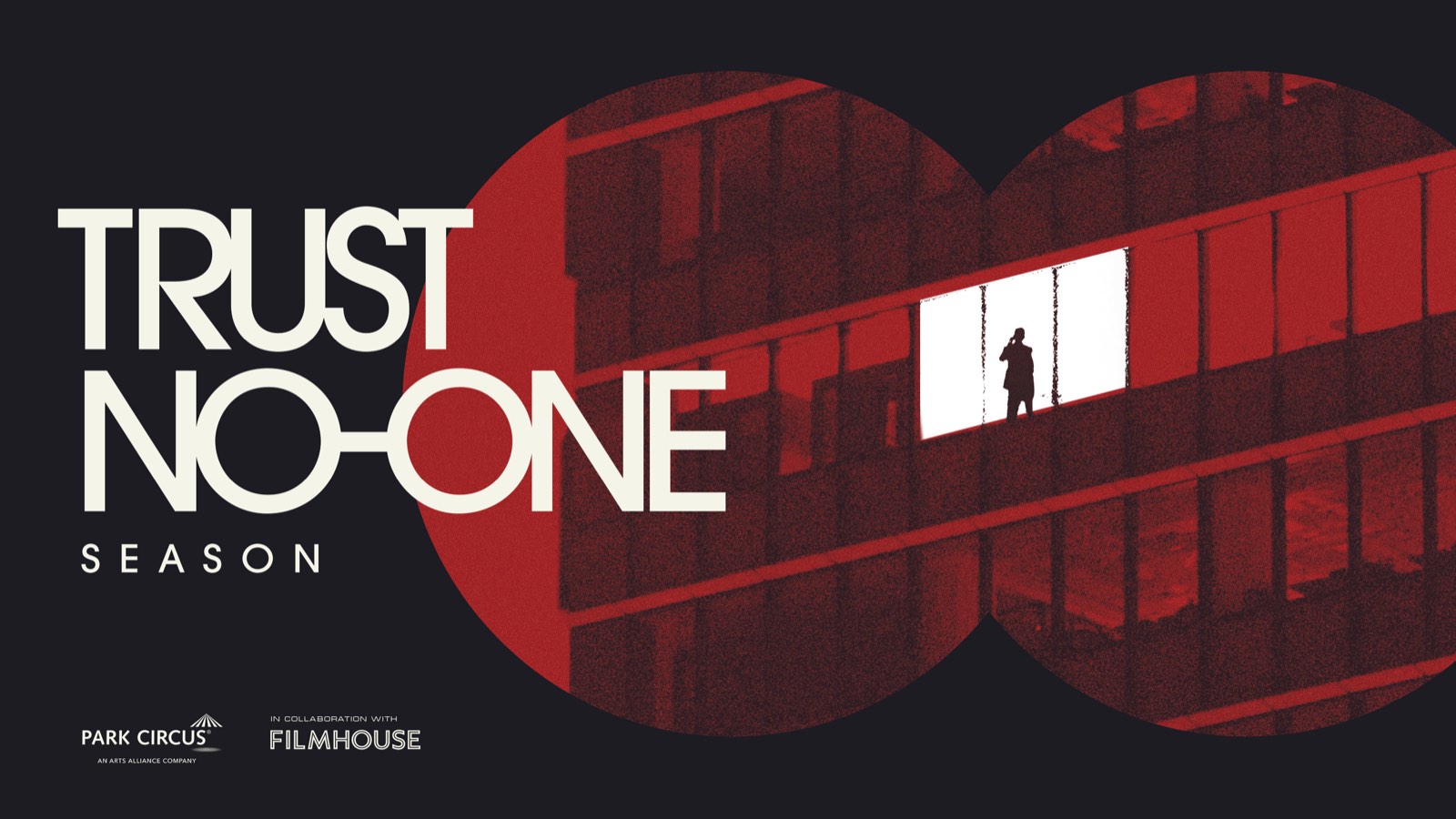
In celebration of the 50th anniversary of All The President's Men, Park Circus presents Trust No-One, a brand-new season of five classic paranoid thrillers curated by our friends at Filmhouse and available to book now via Park Circus on a single cost-effective DCP combo drive (UK/EIRE only).
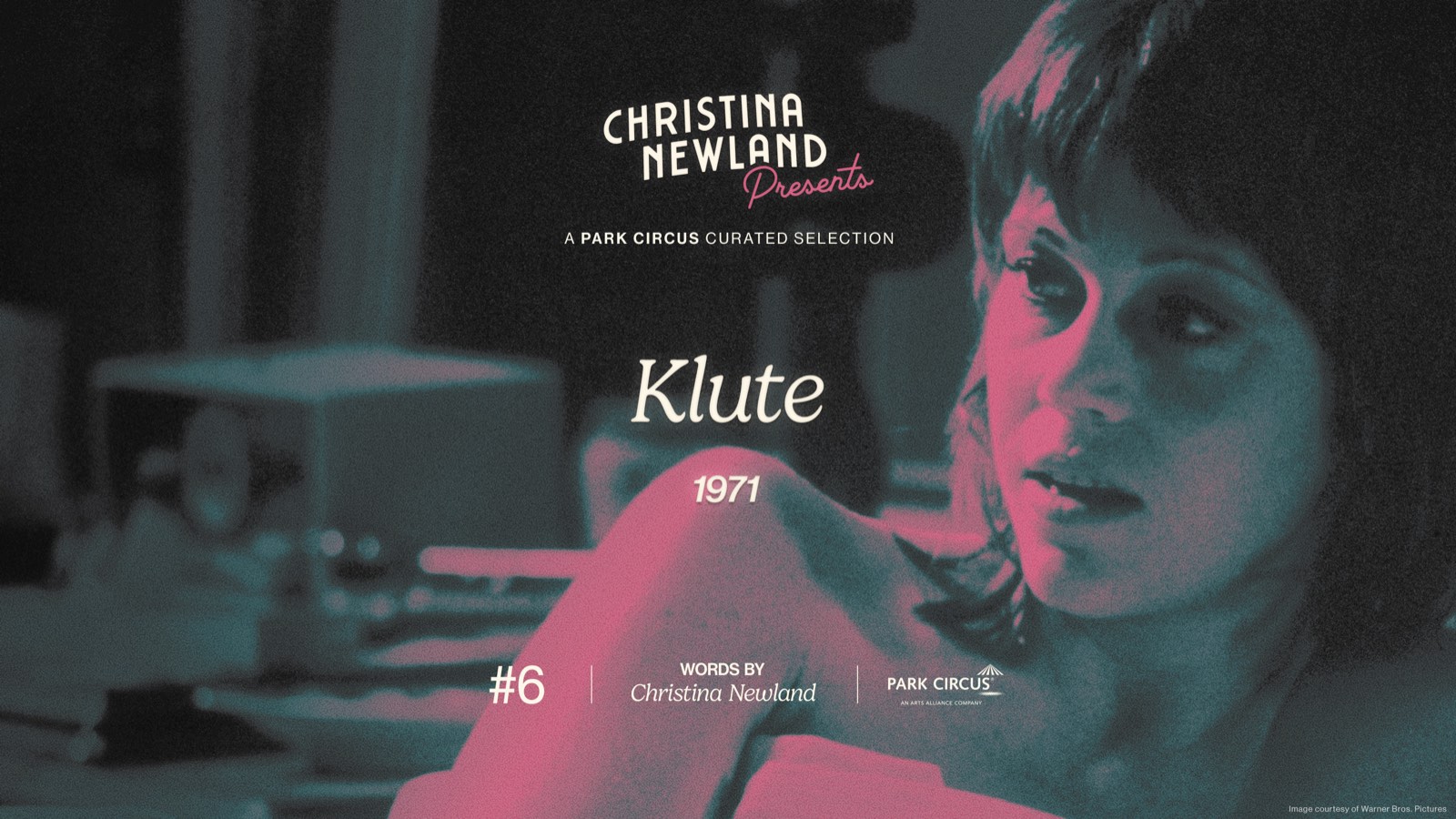
Trust No-One is supported by two sets of brand-new programme notes with season curator Raymah Tariq (below) contextualising this package of titles, alongside a spotlight on Klute from critic and journalist Christina Newland. The package is further supported by new season artwork (above).
The following programme notes (also available for exhibitors and audiences in PDF) explore and contextualise the titles featured in Trust No-One. Words by Raymah Tariq.
Earlier this year, I happened to watch Sidney Lumet’s The Anderson Tapes (1971) and found it to be a complete curiosity – it appears to anticipate the paranoid thriller before the genre emerged as its own distinctive tone. Upon realising that Lumet was at the cusp of a genre before it was more fully formed, it then only speaks to question – which films are now considered the foundations of the genre? And what hallmarks did The Anderson Tapes have on future films?
Coincidentally in May, Filmhouse sought to play Alan J. Pakula’s All The President’s Men (1976) for its 50th anniversary, which brings us nicely back around to answering our earlier question. A full retrospective of Pakula’s paranoid thriller trilogy (Klute (1971), The Parallax View (1974)) was overdue allowing the audience to see how Pakula honed and developed this sense of tone which ultimately results in All The President’s Men being such a definitive and accomplished piece of work. As a result, finally (!) the perfect context to play The Anderson Tapes, and of course, what many consider the apex of Paranoia Films – The Conversation (1974).
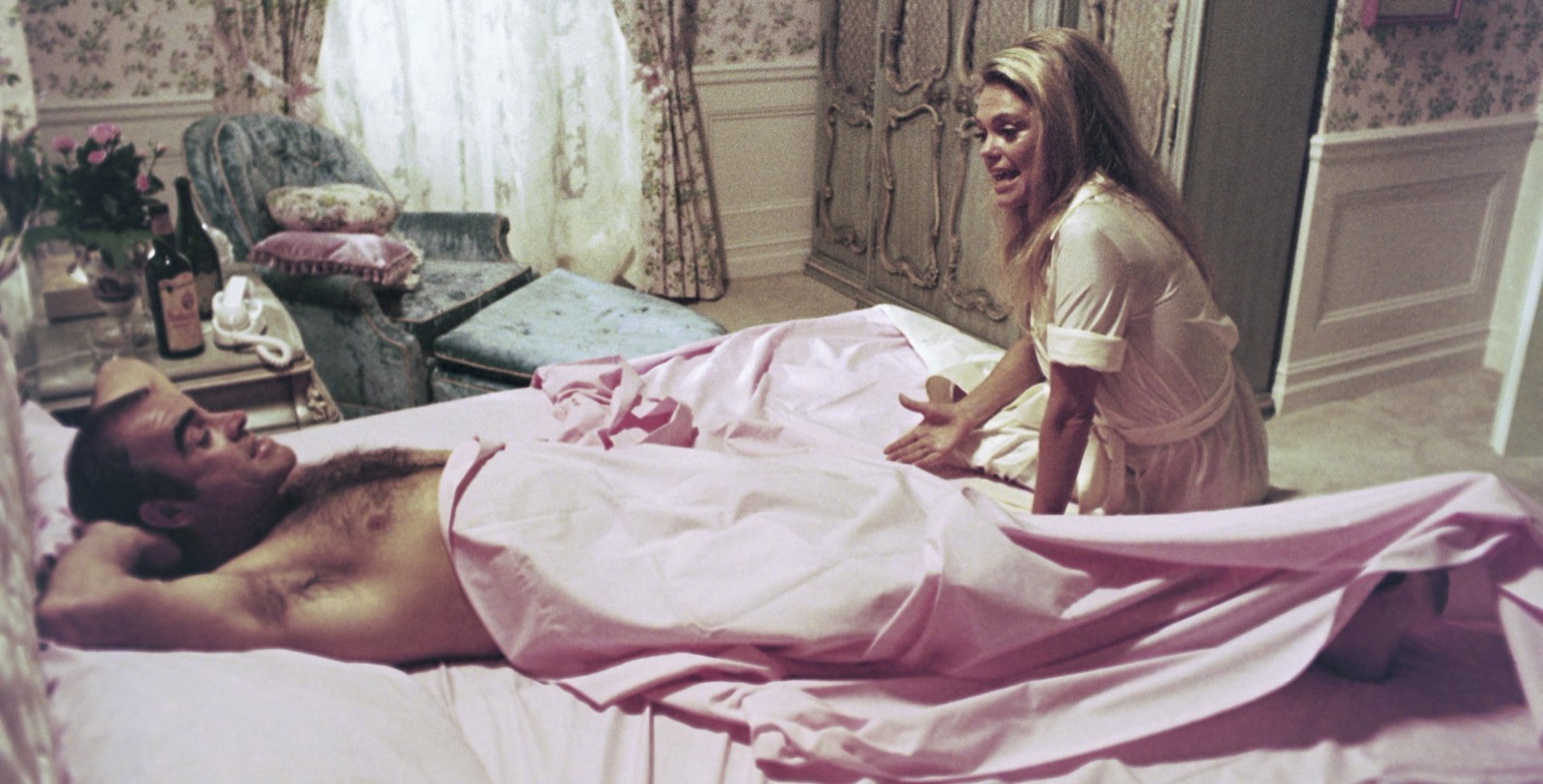
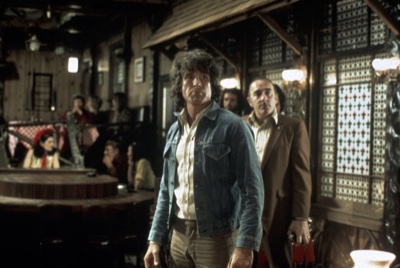
Credit: The Anderson Tapes © 1971, renewed 1999 Columbia Pictures Industries, Inc. All Rights Reserved.
Sidney Lumet’s The Anderson Tapes, released in 1971, is a curiosity which appears to anticipate the paranoia thriller before the genre emerged as its own distinctive tone. Setting down to make a heist film, where the thieves’ movements are being watched as they mastermind their great plan, there are moments where you may think, ‘is this sci-fi?’ – such is the disorientating electronic tone the score occasionally takes, departing from its more classic heist-coded music of jazz as scored by Quincy Jones.
The Anderson Tapes sits betwixt genres and perhaps, as a result, is a bit forgotten despite being lauded for aiding Sean Connery in distinguishing himself from being more than ‘just Bond’. The film is also notable for introducing Christopher Walken in his first major role. Columbia Pictures and Lumet, known for preferring established and well-trained actors, knew what they were on to when he was cast – ‘and introducing Christopher Walken’ text is splashed onscreen as we see the man himself strutting out of a prison room.
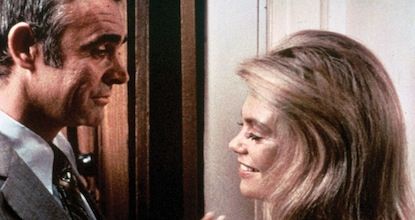
Twenty-eight-year-old Walken is affectionately referred to as ‘The Kid’ in a ragtag line-up of thieves led by Connery’s cool and assured character, ‘The Duke’. The plan? To rob every apartment in a New York block where The Duke’s former girlfriend now dwells. Little do they know; a variety of agencies are wiretapping different apartments for their own purposes. As The Duke reconnects with his old flame, parts of his plans are unwittingly disclosed to a private eye spying on her.
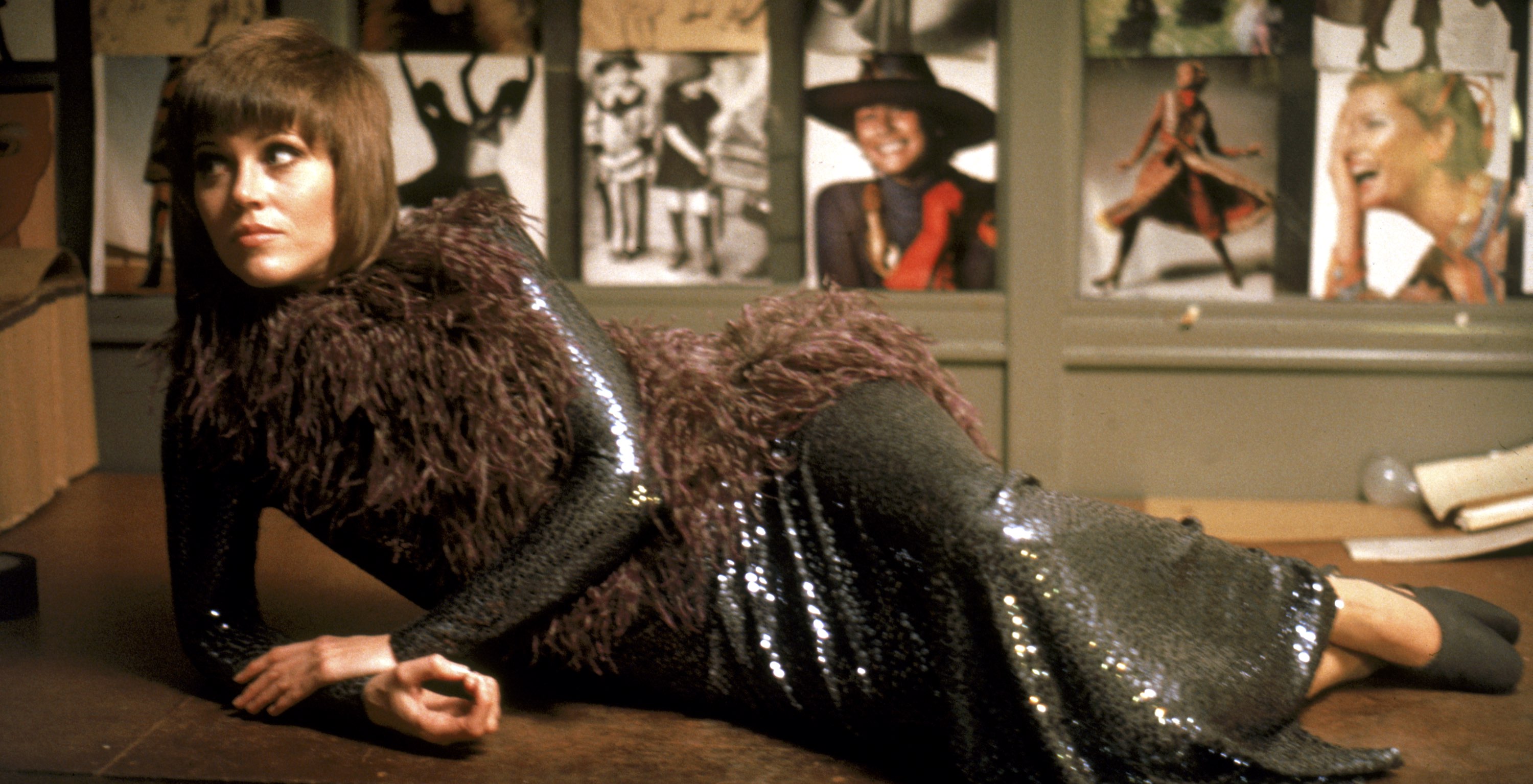
Credit: Klute (1971). Image courtesy of Warner Bros. Pictures
Perhaps Lumet didn’t realise what sort of film he was making at the time. House Cybernetic font appears onscreen to divulge locations, giving a slight futuristic edge that has become familiar to see in sci-fi. But this is not a futuristic sci-fi: the future is here, and the future is surveillance.
At the same time, Alan J. Pakula was working on Klute. Pakula had produced films before (including [To Kill a Mockingbird](https://parkcircus.com/film/114352-To-Kill-a-Mockingbird, 1962) and was looking to establish himself amidst the New Hollywood scene as a director and, despite having initially been turned down by Warner Bros., eventually landed the gig to produce and direct.
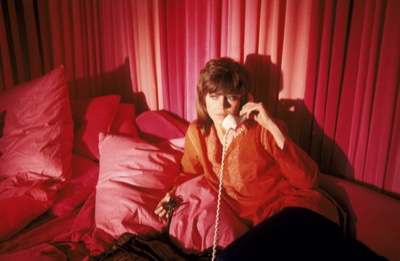
Pakula cast Jane Fonda as sex worker Bree Daniels, a complex character to whom Fonda brought even further dimen sion after doing her own research with sex workers in New York. It was a role which led to her Oscar win and many still wonder why the film was not named ‘Bree’. The titular Klute is in fact, Donald Sutherland, a detective tasked by a family friend to investigate the disappearance of a com pany executive with a connection to Bree. Klute begins to track Bree’s movements and taps her phone as a means for a lead — until tracking her becomes more important than solving his case and she senses she is being watched.
Some say it’s hard to know how much the original intent of Klutewas to be a paranoid thriller, but screenwrit er Andy Lewis says the theme was intentional, “… the hidden pattern of things. The darkness. The people out there watching you, plotting against you, waiting to hurt you. Sounds you hear at night. Silences on the phone.” Whilst Klute does not yet have the full conspiracy machinations of later paranoid thrillers, what it does begin to define, courtesy of Gordon Willis, one of the most defining cinematographers of all time, is its style. Close-ups of characters with a slow steady pan out showing their vulnerability in a big bustling city, shots of Bree covered in shadows (Willis is dubbed “The Prince of Darkness” after all, although, he did not care for the moniker), her eyes just peeking out; an unsettling angle that make us feel off-kilter, like we’re watching from the point of view of a hidden camera.
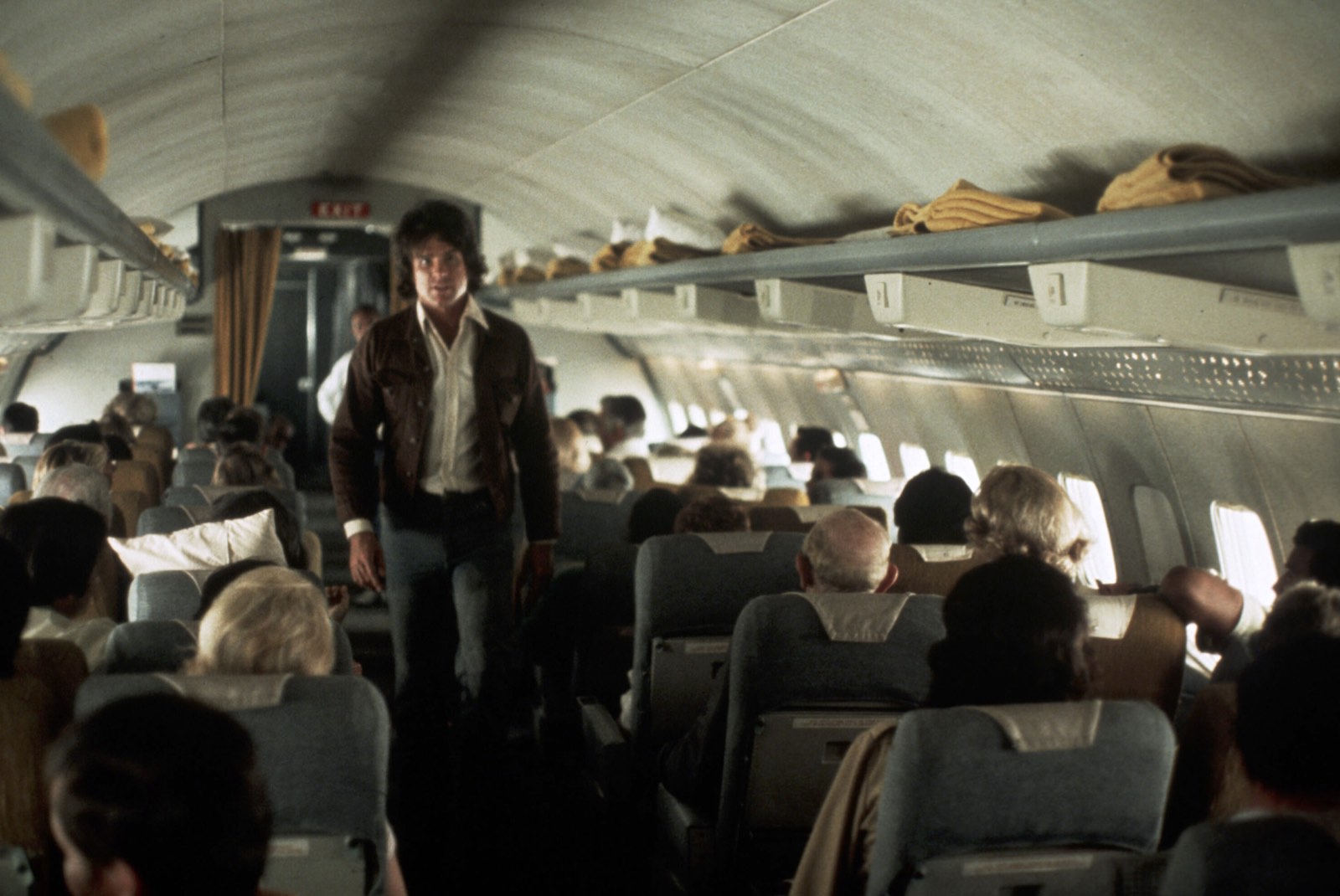
Credit: The Parallax View (1974). Image courtesy of Paramount
Pakula and Willis team up again in 1974 with The Parallax View. ‘As American as apple pie’ reads the tagline, starring Hollywood darling Warren Beatty. This political thriller failed to become a box office hit at the time but has aged like a fine wine and not a moment is wasted in its 102 minutes of runtime.
As soon as the film opens, we witness the assassination of a senator on a campaign stop, dramatically present ed atop of the Seattle Space Needle. Eyewitnesses to the event start dropping dead and that is when journalist Carter (Paula Prentiss) goes to her former boyfriend, Frady (Beatty) fearing for her life. He turns her away and we are abruptly presented with her body, wrapped in a white shroud in a cold blue morgue. Frady, also an investigative reporter, picks up the trail and soon uncovers an intrigue, driving him to tail a man. But who is tailing who? Frady talks to a source whilst fishing, a red lure whips across the screen and then a siren sounds – Frady is in over his head and yet his obsession is too strong. His curiosity must be satisfied. Pakula plays with a patriotic colour palate of red, white, blue and a dash of American mustard throughout. All of these colours ultimately come together for the film’s shocking finale.
Frady meets people in liminal spaces for information: on a train ride in a fairground going through a dark tunnel, whispering information, faces obscured with gleams of light hitting the face. It’s easy to see Pakula and Willis are honing the visual tempo which we would ultimately witness in All The President’s Men, where we meet the iconic Deep Throat in a shadowy car park.
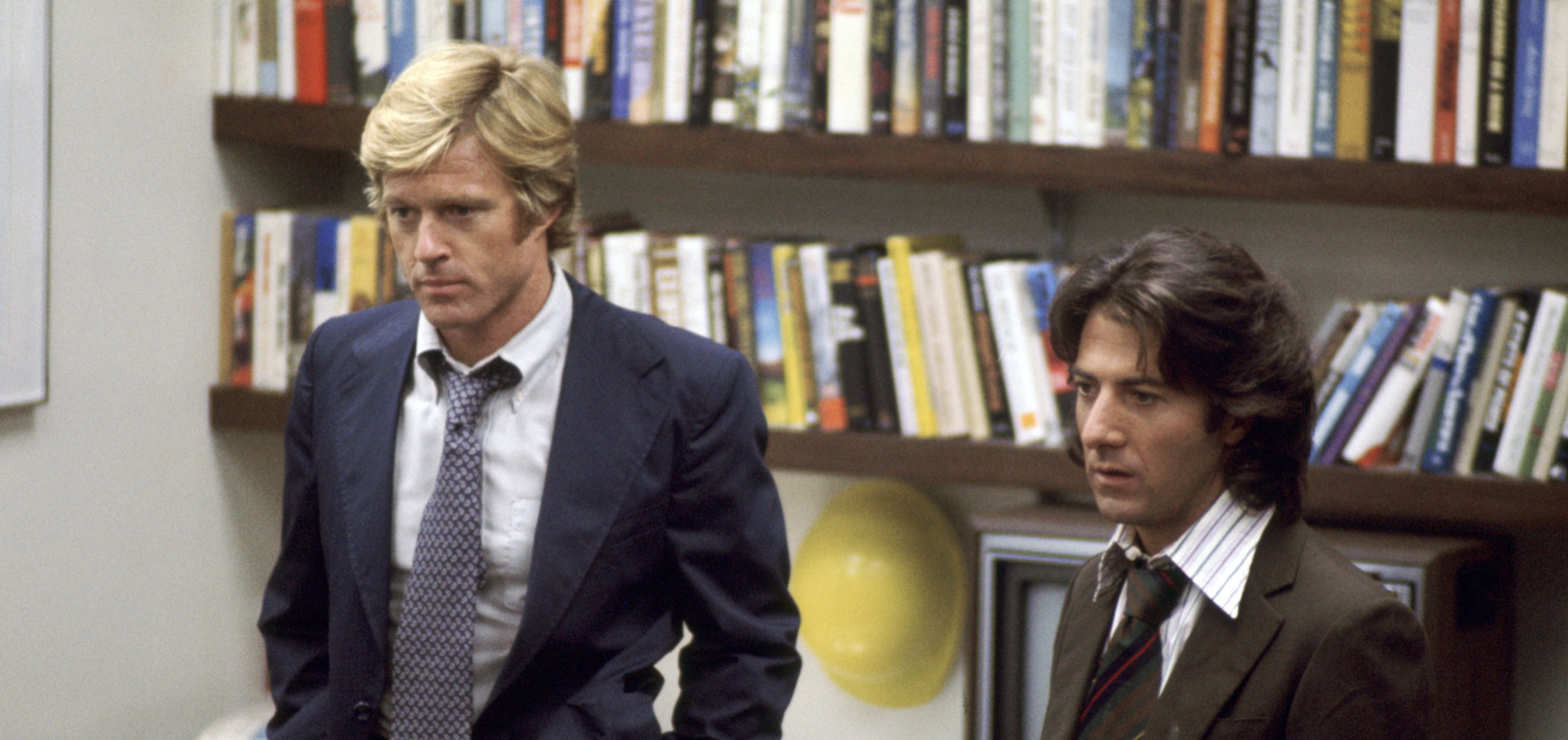
Credit: All The President's Men (1976). Image courtesy of Warner Bros. Pictures
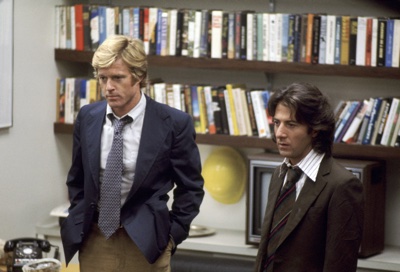
The Watergate Scandal articles by Bernstein and Woodward were avidly read by Robert Redford, who bought the book rights and commissioned William Goldman to piece together the screenplay. Warner Bros. came on to finance and Pakula was hired to direct, bringing in tow his acute attention to building tension and suspicion.
Bernstein (Dustin Hoffman) and Woodward (Redford) work together to build trust with their sources as they investigate a scandal which, at first blush, does not seem all too newsworthy. They sense the endangered safety of their sources, and perhaps also themselves feel encroached upon.
Woodward walks down a street at night, darkness enveloping him (thanks again, Gordon Willis), someone is following him, and he picks up the pace – only for him to turn around… to no one. It’s amusing to read that Andy Lewis set up a very similar scene where Klute is running with the suggestion of no one there, only for Pakula insisting on the slight of a figure to enter the frame. It would seem that yes, the Lewis brothers had indeed worked paranoia into Klute, maybe even more subtly than Pakula was ready to portray… but he got there eventually. The Parallax View and All The President’s Men employ several slow pans outwards as the protagonists are gradually consumed by brutally open architecture, highlighting that surveillance is no longer intensely localized but a pervasive “anywhere” phenomenon.
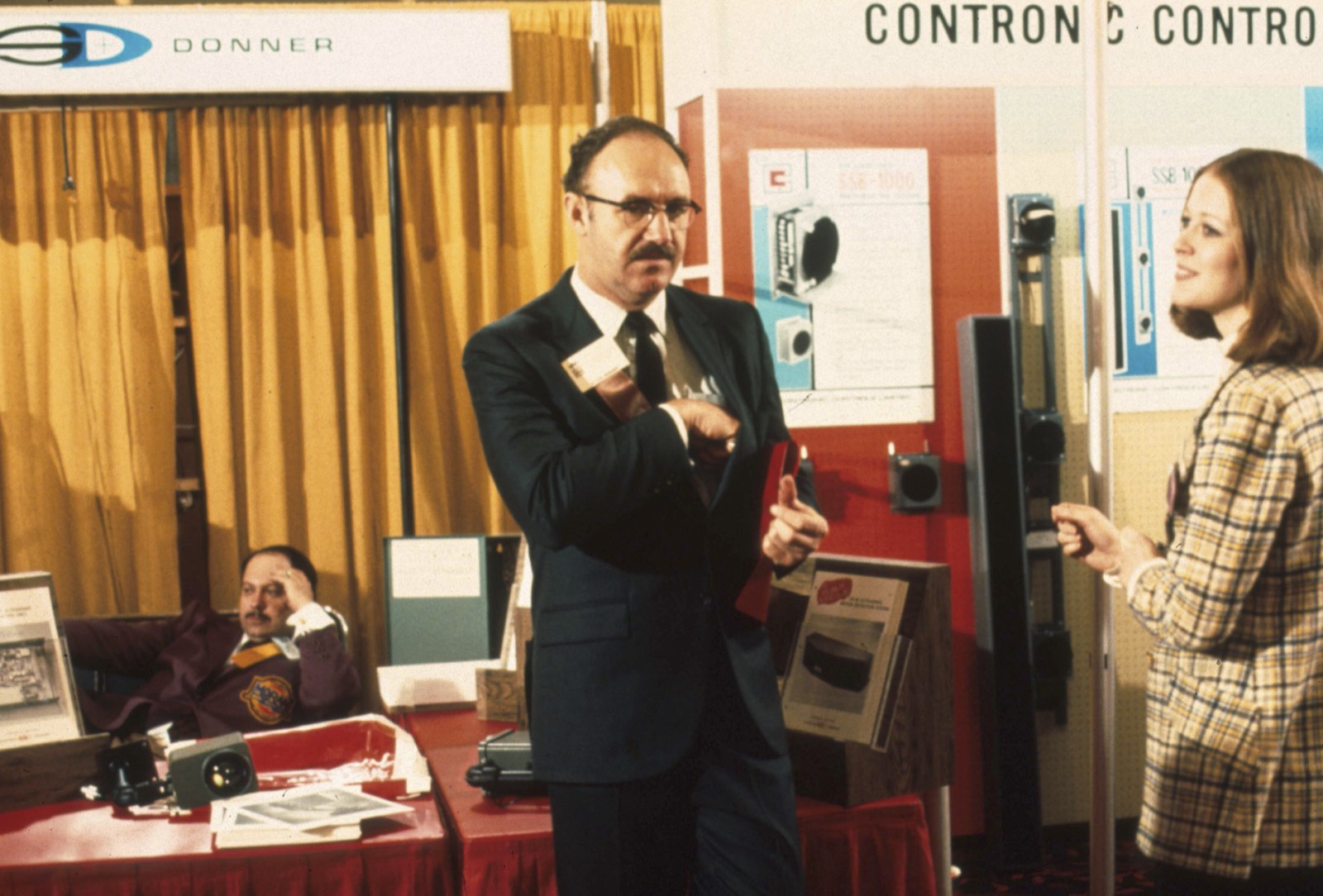
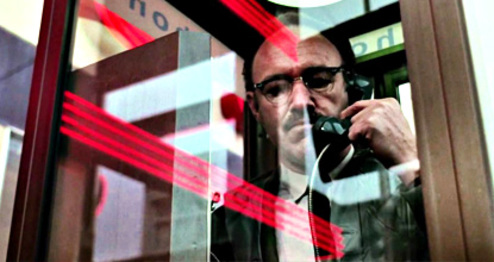
Credit: The Conversation (1974). Image courtesy of STUDIOCANAL
Contrastly, Francis Ford Coppola’s The Conversation commences with a 3-minute zoom-in as the steady, predatory camerawork (high above a crowded public park) and audio distortion result in the viewer captivated and disorientated in equal measure. Electronic bleeps (also used heavily in The Anderson Tapes) punctuate the soundtrack amidst Walter Murch’s incredible diegetic sound design. One man looks through a long-distance microphone akin to a sniper’s scope while another fumbles with his earpiece; two people are talking but we can only grasp intermittent soundbites from their exchange.
“I don’t care what they’re talking about, all I want is a nice fat recording”, freelance surveillance expert Harry Caul (Gene Hackman) exclaims irritably to his assistant (John Cazale). Hired by a mysterious corporate entity to spy on a seemingly innocuous couple, Harry retreats to his office with his tapes to reconstruct the verbal jigsaw. To his peers he is a very measured and respected technician and yet every aspect of his life is reliant on secrecy and emotional equilibrium, a defence mechanism against extreme isolation, deep-seated guilt over the repercussions of his recordings, and the inherent paranoia of his profession. Even his non-work passion, playing the saxophone, is concerned with sound manipulation and control. Now what would happen to a man’s psyche if that control were threatened – say if the watcher feels they are being watched?
Released a few weeks before Nixon’s impeachment hearings began over Watergate, it cannot be denied that The Conversation did indeed ride the cultural zeitgeist. However, it was a critical success too, winning the Palme D’Or at Cannes. It remains a cornerstone of New Hollywood cinema. Over 50 years on, its warnings on the human cost of moral apathy, fear of our actions being documented in perpetuity, as well as increasing loneliness in an electronically connected world are deeply resonant.
With over ten years’ experience within film exhibition and a passion for bringing repertory cinema to the screen, Raymah Tariq is currently Programme Manager at the newly reopened Filmhouse Cinema, Edinburgh.
Note that inclusion of a title within this collection does not guarantee rights or print availability for a specific territory.